
Business West – Keiter Continues Torrid Pace of Growth
Life in the Fast Lane
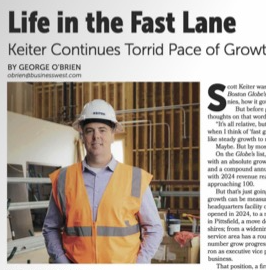
Scott Keiter was asked about his company’s presence on the Boston Globe’s list of New England’s fastest-growing companies, how it got there, and what it would take to stay there.
But before getting to all that, he wanted to offer his thoughts on that word ‘fast,’ at least as it applies to businesses.
“It’s all relative, but Google and Amazon … that’s what I think of when I think of ‘fast growth,’” he told BusinessWest. “For us, it feels like steady growth to me.”
Maybe. But by most all definitions of ‘fast,’ Keiter qualifies.
On the Globe’s list, Keiter is ranked 23rd (it was 32nd in 2025), with an absolute growth rate between 2021 and 2024 of 158.41%, and a compound annual growth rate over that period of 37.23%, with 2024 revenue reaching nearly $54 million and the workforce approaching 100.
But that’s just going by the numbers. At this 17-year-old company, growth can be measured by everything from expansion into a new headquarters facility on Interstate Drive in West Springfield, which opened in 2024, to a new office in the Clock Tower Business Center in Pittsfield, a move designed to better serve clients in the Berkshires; from a widening of the company’s territory — the current service area has a roughly 60-mile radius, and the plan is to see that number grow progressively higher — to the hiring of Matt LeBarron as executive vice president to handle the operations side of the business.
That position, a first for the company, signals a certain stage of maturity and development for the company, said Keiter, noting that he and his wife, Jill, the company’s director of Administration, are now able to step away from the day to day and focus more on business development and long-term planning (more on this later).
Meanwhile, the company’s growth can certainly be measured by an expanding portfolio of projects — with current work including everything from school renovations to construction of large housing complexes — and more large projects, as we’ll see.
When getting around to how the company got on the Globe list and achieved such growth, Keiter — while again questioning how fast is ‘fast,’ and noting that inflation is offsetting some of this growth — said much of it comes down to quality work that generates solid word-of-mouth referrals and more work on the schedule, as well as continuously reinvesting in the company.
“We invest in our people, our systems, and processes, and I think our trajectory has been relatively consistent, at least over the past five to 10 years,” he said. “There’s been steady growth.”
This is true across the broad spectrum of work handled by Keiter, from residential remodeling and new building to commercial work, as well as the fastest-growing segment of the portfolio, what Keiter calls institutional work, especially within the region’s large education sector, both public and private, and larger-scale residential construction.
Indeed, current work includes projects at Williams College, Deerfield Academy, Holyoke Public Schools (renovation of Kelly Elementary School), and Smith College, while the portfolio is replete with many different projects at Smith and others for Mount Holyoke, Western New England University, Amherst College, and other institutions.
On the residential side, the company is handling a 30-unit project for Valley CDC in North Amherst, as well as a project in Hadley to convert the former Econo Lodge into 50 apartments.
“We want to continue to invest in being a solution to the housing challenges we have,” he told BusinessWest. “We’re really passionate about that; we’re working with Way Finders, Valley CDC, and other developers to create housing solutions.”
For this issue and its focus on construction, we take an in-depth look at Keiter, its strong growth trajectory, and the business plan moving forward.
Building Momentum
As he talked with BusinessWest in his office in the West Springfield location, one that puts operations that were spread across three offices in Florence under one roof, Keiter gestured out the window toward a line of trees at the edge of the property.
“If they weren’t there, you could see the turnpike,” he said, noting that I-91 is also just a stone’s throw away. And this location was chosen for this very reason, he said, adding that crews working out of that office can get somewhere in any direction quickly and easily.
And Keiter personnel are, indeed, heading in all four directions, and to a wide range of jobs.
The company does much of its work in Hampden and Hampshire counties, but it also has projects in Connecticut, Central Mass., and the Berkshires, where it is gaining a solid foothold with the project at Williams, an undertaking for Hillcrest Educational Centers, and other initiatives.
Beyond geography, the company is focusing on several segments of the construction market, operating with an integrated-services model that provides a one-stop solution for projects of all sizes.
On the residential side, the company is still handling new construction of single-family homes and renovation projects, but it is being far more selective than it was years ago, said Keiter, adding that the firm’s focus is on larger-scale initiatives, such as the 30-unit project (15 duplexes) in North Amherst, which is now nearing completion.
Overall, much of the company’s recent growth has come on the commercial side of the ledger and the institutional sector, where it is “doubling down,” as he put it.
“That’s the primary sector that we’re focusing on, but we’re also growing with mixed-use and larger-scale residential construction,” he said, adding that the company has many repeat customers, but adds new ones to the portfolio via strong word-of-mouth referrals.
“We work very hard to earn those referrals,” he added, noting that they certainly help in an increasingly competitive construction market, one that features a number of firms based in the 413 and a growing number of companies outside it that are increasingly chasing work in this region.
“We’re often seeing contractors from Worcester and beyond working with developers,” he noted, adding that this is a recent phenomenon, but it has become more of an issue in recent years. “And there are contractors from pretty deep in Connecticut coming up; a lot depends on the project size and the client.”
At any given time, the company is working on as many as 30 projects of various sizes and at various stages, from pre-construction to wrap-up work, with plenty of work on the books for the rest of this year, 2027, and even early 2028.
Increasingly, and especially with the hiring of LeBarron, this work is focused on what Keiter called the “front end of the business” — sales, estimating, pre-construction, developing projects, working with clients, setting up teams for the next steps, and supporting the employees at all levels of the company.
“I get involved just enough not to cause chaos,” he joked, adding that he’s in the field less and in his office more, a pattern that is taking some getting used to. “Jill and I built this business, and the people around us have built this business to the point where we just want to step aside and let them do what they do. We learn something every day from the folks we have here — it’s very impressive.”
As for LeBarron, he brings a diverse background to his role with Keiter, one that includes work with Turner Construction in Boston and then in Connecticut, mostly on the superintendent’s side, but also cost analysis, for several large-scale projects. He later worked for Dimeo Construction in Providence for two years before working for Shawmut Design and Construction in Boston and then as a project manager at Yale University, handling 60 to 80 projects at any given time and $100 million a year in work.
He then returned to Shawmut to manage its Connecticut office for more than two years before the company downsized its portfolio in that region, leaving him looking for a new opportunity.
He found one at Keiter, where he was drawn by the owners’ long-term vision for the company, its family-like culture, and its core values.
“They’re building for the future,” LeBarron said. “And they’re putting the groundwork in place so they can grow without issues.”
Bottom Line
Looking ahead, Keiter said the company is continuously revising a strategic plan that currently calls for geographic expansion — moving out progressively further from that current 60-mile radius — as well as a continued push into the institutional market while also being a primary driver on the housing front, especially the affordable segment of the market.
The plan also calls for continued reinvesting in processes, systems, and technology. “I call that inward growth,” he noted, listing everything from new accounting software to leadership training for employees.
All of this is contributing to a strong rate of growth — whether one calls it ‘fast’ or ‘steady’ — that he attributes to teamwork on many levels, relationship building, quality work, and diversity — movement into different realms within the construction sector.
This pattern will continue into the future, Keiter said, adding that his company has constructed a very solid foundation and will continue building on it.